Nesanel DevorFri, Apr 17 10:33 PM
Day 37. Avak Loshon Hara/ Excessive Praise: It is forbidden to praise a person in front of anyone who doesn’t like him. Why not, I’m saying good things about him no? Well yes, but the listener may contradict you by saying “you really think he’s so great? I can tell you information about him that will make you change your mind” 🫣. It is also forbidden to praise someone in an extreme manner even if it’s not said in front of his “enemies” 😮. Why? Great question. Because some people have a natural instinct that when they hear too much praise about someone, they automatically try to find faults and talk about it. (The exception to the rule is as follows…. When you are talking about a well known tzaddik.
AvrohamSun, Apr 19 3:12 PM
Day 38. Segula For Parnasah: We become very enthusiastic when we hear about a segula for parnasah, like saying parshas ha’man or baking challah with a key after pesach….most of us would opt to try the segulah. The Chofetz Chaim enlightens us that the most powerful segulah for parnasah is guarding our speech🤯. The tzadik gets his proof from parshas Bo…. We know that at the time of Makos Bechoros none of the dogs barked at the yidden. Because of this, the dogs received an award. Throughout all generations, we are instructed to give treif meat to them. thus, they are always assured of their parnasah. Now, if an animal receives an eternal reward for controlling himself from barking for only one day, then certainly a yid who controls himself from speaking Loshon Hara, will be assured Parnasah in abundance.
Nesanel DevorMon, Apr 20 8:25 PM
Day 39. Avak Loshon Hara: It is forbidden to praise someone in a way that can cause him financial harm. For Example: Your neighbor lent you a large sum of money. It is forbidden to announce this publicly. Why? Great question. It is because this may cause a lot of people to flock your neighbors door in the hope of being the recipient of his generosity. However, if someone asks you specifically, “Do you know who would lend me money?” Then you may mention your neighbor’s name. However, you *should* add, “please don’t publicize this.” If you know the person is the type that will not listen to you, then it would be forbidden to answer him who lent you the money.
AvrohamMon, Apr 27 6:34 PM
Day 44. Repeating a secret: When someone reveals private information to a group of 3 or more and says specifically, “don’t pass it further”, then it is forbidden to spread. However, if a person doesn’t specify in front of 3 then it would be permissible to pass it further. (Obviously this is if there’s no loshon hara involved).
AvrohamTue, Apr 28 7:20 PM
Day 45. Revealing confidential information: You are part of a school meeting that is voting if a teacher should be fired or not. The outcome of the vote is that she should be fired. The Halacha is that you are not allowed to tell the teacher who voted against her. It is even forbidden to tell her “I voted in your favor”. Why? Because by process of elimination, she might figure out who voted against her, thus ill feelings will emerge.
Nesanel DevorWed, Apr 29 12:49 PM
Day 46. About whom is it forbidden to speak loshon hara: It is forbidden to speak Loshon Hara about any Jew regardless of their age, relation, or level of Torah knowledge. Therefore it is forbidden to talk negatively about……… Any Frum Member In Klal Yisroel: All yidden are deserving of our respect *even if we disapprove of their lifestyles or cultures* 🙃.
Nesanel DevorWed, Apr 29 3:29 PM
* Even non- frum nowadays are considered תינוק שנשבה and therefore would be complicated to talk Loshon Hara about them as well.
AvrohamThu, Apr 30 9:33 PM
Day 47. Satmar rebbe story: During the war, when Poland was one of the first countries to be overcome by the Nazis, there were some yidden that managed to escape to Hungary and other countries that were not yet invaded. In Hungary the Satmar rebbe zt”l selflessly sustained these refugees with shelter, food and morale support. Once, a chossid approached the rebbe and informed him “I saw some of those yidden not keeping Shabbos!” The rebbe was unmoved. He claimed, “these refugees are broken in spirit and thus, they cannot be truly judged for there actions.” 🤯🤯🤯
Nesanel DevorSun, May 3 12:36 PM
Day 48. About Whom Is It Forbidden To Speak Loshon Hara: Although, at times it is permissible to talk negatively about a rasha or apikoras, we must still have to be aware of a very important point. Most people who do not keep mitzvos do not fall under the category of reshaim or apikorsim. Therefore they are deserving of our love and concern and we may not speak against them. Now who are we referring to? People who were raised in a non- frum home and were never taught about mitzvos. Such people are considered “tinokos shenishbu”- children who were kidnapped.
AvrohamMon, May 4 9:42 PM
Day 49. Children: An area of Loshon Hara in which people are not aware of the Halacha is with children, people thing there is free range when talking about them. This is not true. Loshon hara is forbidden even by children! However, Behavior which is considered age appropriate for that age is permissible to say. Example: “The 2 year old next door throws tantrums all the time” or, “my 5 and 6 year old cousins keep on fighting”. Such statements would be permissible, However, if as a result of discussing a child’s behavior it’ll cause the child harm, then it is forbidden.
Nesanel DevorWed, May 6 12:34 PM
Day 50. Family Members: Some people try to be cautious when talking about others but when it comes to family members they think they can say whatever they want. This is a grave mistake. By degrading their own family, they can cause untold harm to the people they love most. It is forbidden to talk Loshon Hara *about* and *to* family members. This includes parents, spouses, in-laws, siblings, one’s own children.
AvrohamThu, May 7 9:56 AM
Day 51. Age appropriate: Behavior which is not considered appropriate for a child that age is loshon hara and forbidden to relay. However, if you need to ask advice on how to deal with a child, then it is permitted. Nevertheless, one should say only negative information that is necessary to relate and only to a person who can offer advice. Children who are over bar/bas mitzvah fall under the category of adults, therefore talking about a teenagers negative behavior (even if it is age appropriate) is forbidden to relay. It is also forbidden to talk negatively about past history of a child even though you are saying that the child has improved since then.
AvrohamFri, May 8 3:47 PM
Day 52. Family: Talking about one’s parents in a negative light is Loshon hara. It is also forbidden to talk Loshon hara about one’s siblings (even if it’s to other siblings or parents). This is forbidden, even if the information is well known in the family. It is also forbidden to talk Loshon hara about one’s own children.🤯
Nesanel DevorSun, May 10 9:08 PM
Day 53. Just as it is forbidden to talk Loshon hara about a yid who is alive. So too, it is forbidden to talk about a yid who is no longer alive.
AvrohamMon, May 11 9:35 PM
Day 53. About whom is it forbidden: Some people think that it’s forbidden to speak about one person but not against a group. In fact, it is much worse to speak against a group even if you don’t mention any names of the people in the group because now you just said Loshon hara about multiple people instead of one person. For Example: “The girls in that school are very snobby.” Or “Those chasidim are very aggressive.”
Nesanel DevorTue, May 12 12:53 PM
Day 55. About Whom Is It Forbidden: Even though a machlokes is well known, it is still forbidden to talk negatively about either side. One should not make a general negative statement about the people involved in the machlokes.
AvrohamThu, May 14 1:57 AM
Day 56. To whom is it forbidden: It is forbidden to talk loshon hara even if it’s to a non-jew. The danger of talking to a non-Jew is much worse than talking to a yid. Why? Because we have the mitzvah of being Dan lkaf zchus and not believing loshon hara. However, a non-Jew will automatically believe your words as fact, thereby causing untold harm.
Nesanel DevorThu, May 14 12:40 PM
Day 57. There’s a story from the late 1800’s that many gedolim were in an important meeting that took place in Russia. Among the some that were there were the Chofetz Chaim and a chassidic rebbe. The gedolim were trying to set another meeting so that they can discuss some important issues. At the meeting the Chofetz Chaim was whispering to the rebbe. Some try to eavesdrop and listen and here’s what one heard. Chofetz Chaim- “I wanted to ask you if I can be excused from the next meeting.” The rebbe- “Why don’t you want to attend.” The Chofetz Chaim- “From my youth I always tried to keep away from talking negatively in anyway about people. I know there will be discussions about candidates and it’s possible negative comments will be relayed about the candidates.” The rebbe- “But what about your city Radin? There were meetings about who the next rav would be, I’m sure they asked you to attend.” The Chofetz Chaim- “ That’s exactly why I went away from the city the exact time they were choosing a rav so that they wouldn’t be able to ask me to join the meeting. By the time I came back the new rav was chosen.” The one who heard this said. “It is impossible to put on paper how these pure words spoken from the Chofetz Chaim’s mouth affected the people who heard them, the lesson remained in their hearts for the rest of their lives.” This story above shows deeply how much the Chofetz Chaim had the strength and chose to not put himself in harms way to potentially be in a position to speak bad of others or even hear negativity about others. The Chofetz Chaim showed us that it really is possible control ourselves and the way we speak. May we all have the strength to acquire exactly what the Chofetz Chaim did and continue building ourselves to not speak bad of others.
AvrohamFri, May 15 6:41 PM
Day 57. Emotionally Hurt: Some people think that it is ok for a husband and wife to have free-ranging conversations. *This is false*. The issur of loshon hara applies even between a husband and wife. If either spouse wants to discuss negative information for a constructive purpose, all rules of toeles must be applied. If one is emotionally hurt, they may share their feelings with following conditions. - If possible try not to reveal the name of the person who hurt you. - If possible try to tell only one person about it so they can make you feel better. - The person to whom you choose to unburden yourself, should be someone who is careful in hilchos shmiras halashon.
Nesanel DevorSun, May 17 9:14 PM
Day 58. Children: From a young age, children should be trained to keep Hilchos Shmiras Halashon. If you hear your child talking Loshon hara, you are obligated to stop them. This is one of the biggest favors you can do for your child! Of course, the best chinuch is by example….
AvrohamMon, May 18 10:43 PM
Day 59. תשובה for Loshon hara😬😬😬 •We must admit to hashem that we spoke Loshon hara. • We must feel regret for saying over the Loshon hara. •We must take upon ourselves not to talk Loshon hara in the future. If the loshon hara was accepted and caused harm there is an additional step to תשובה •We must ask mechila from the person about whom we spoke. This is almost impossible to do because we don’t know where everyone is or we are just to ashamed to tell them. And for sure if you spoke about a whole group it would be impossible to track down everyone. May hashem help us guard ourselves from this dangerous aveira.
AvrohamTue, May 19 10:39 PM
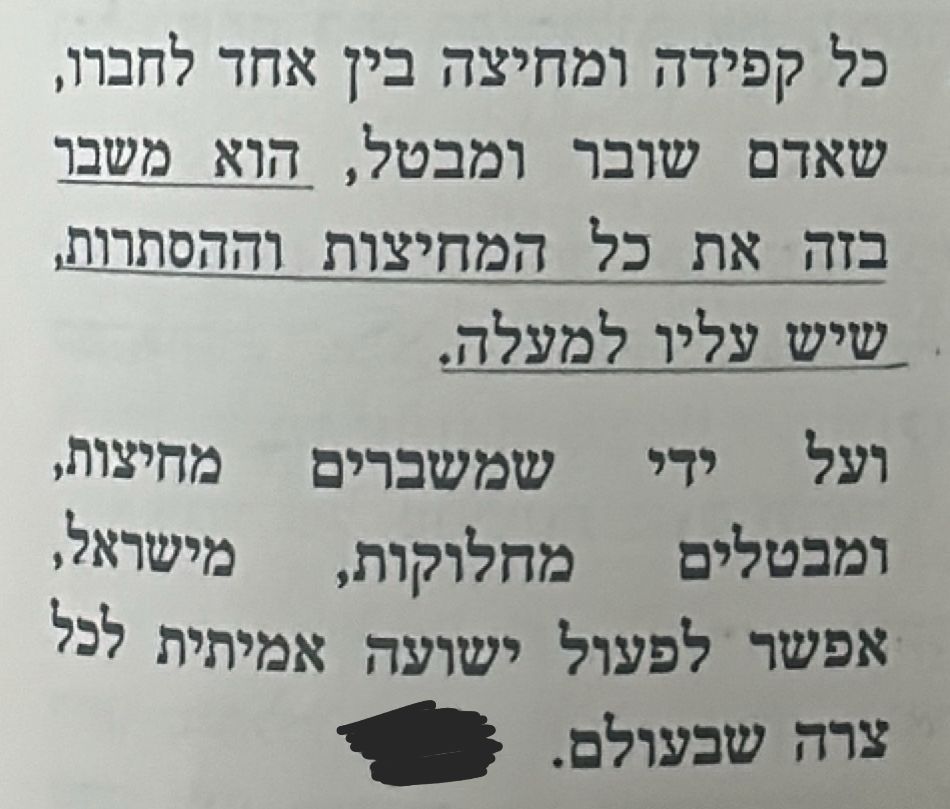
Day 60. Reb itche Meir morgenstern on אחדות: “Every grudge and barrier that a person has with his friend which is erased, you break all of the barriers and blockages that are on you in shamayim. And through this action of breaking the barriers and erasing machlokes, you can bring real salvation for all the pain in the world!!”
AvrohamThu, May 21 2:47 AM
Day 61. What is rechilus: Rechilus is speech which can cause hatred between two yidden. Example: you tell your friend, “reuvan said you are irresponsible.” Revealing this information is forbidden because it will cause the listener to experience ill feelings against a fellow yid.
Nesanel DevorSun, May 24 8:09 PM
Day 56. Rechilus: Relaying information which is not negative about someone, yet will cause ill feelings to the listener is Rechilus. Example - Reuven and Shimon are partners in business. You heard that Reuven was looking for a new partner and then decided against it. It would be forbidden to tell Shimon, “You know, your partner wanted to break up the partnership.” Now why would you think that this is forbidden? Because this can cause Reuven to bear ill feelings against his partner.
Nesanel DevorSun, May 24 8:11 PM
Day 62. Rechilus: Relaying information which is not negative about someone, yet will cause ill feelings to the listener is Rechilus. Example - Reuven and Shimon are partners in business. You heard that Reuven was looking for a new partner and then decided against it. It would be forbidden to tell Shimon, “you know, your partner wanted to break up the partnership.” Why would you think that this is forbidden? Because this can cause Shimon to bear ill feelings against his partner.
AvrohamMon, May 25 10:12 PM
Day 63. Rechilus: One can be guilty of speaking Rechilus without telling the person something new. For example: your sister tells you, “today I took my children to the dentist. It was so hectic, they were all crying and nagging me.” Since you are concerned for your sister, you ask her, “where was your husband? Why didn’t he come along?” Although you meant well, you just said over Rechilus because you caused your sister to feel annoyed at her husband for not helping her🤯
Nesanel DevorTue, May 26 7:43 PM
Day 64. Rechilus: If through one’s comment one reawakens ill feelings that existed between two people, it is Rechilus. For Example: You know that when your friend borrowed your neighbors bike, it broke. At a later date, you mention to your neighbor, “You know, when some people borrow bikes, they’re not so careful.” *This is rechilus even if you didn’t mention your friends name*. But why? There was no mention of any names. It’s because as a result of your comment, your neighbor will remember what happened to his bike. Thus, you have reawakened ill feelings.
AvrohamThu, May 28 1:46 AM
Day 65. Rechilus: In the event that a person knows that something was done against him, and he doesn’t know who did it, it is forbidden to reveal who the culprit is. For example - Your neighbor notices that his car window is smashed. Although you saw how your friends ball accidentally smashed the window, it would be forbidden to reveal this to your neighbor. In such a case, you should ask a rav what to do.
Nesanel DevorThu, May 28 9:56 PM
Day 66. 2nd Level Rechilus: If your friend tells you that someone spoke against you, it is forbidden to go back to that person and ask them “Why did you say that about me”. It is also forbidden for your friend to tell others about what was said about you (even if he doesn’t tell you about it). Why you may ask? Because…. • By publicizing the comment, it will eventually get back to you. • By repeating the comment, he is saying that someone spoke loshon hara. • By repeating the comment, he is also guilty of speaking loshon hara about you.
AvrohamFri, May 29 7:37 PM
Day 67. Tefilah from the chofetz Chaim:

Nesanel DevorSun, May 31 12:57 PM
Day 68. Rechilus: Repeating information which can cause ill feelings is forbidden even if you… • Write the information. • Agree with the information. • Would repeat it in the presence of the speaker.
AvrohamMon, Jun 1 8:26 PM
Day 69. Rechilus: What is the Halacha in the following case? A person is disturbed about an action that was done against him. If he comes before a group, and asks, “who did it?” You may not tell him (even if you feel that he is accusing you of doing it). However, what is the Halacha in the following case? At the time that the person is investigating who did it, there are only two people present - you and someone else. The Halacha is as follows: - if the offense that was done was severe, then you are not obligated to take the blame. - however, if the offense was mild, then you should take the blame.
Nesanel DevorTue, Jun 2 7:10 PM
Day 70. Rechilus: The Yetzer Hara works tirelessly to influence yidden to speak Rechilus as a result causing the flames of conflict to be ignited. As well, the Yetzer Hara is very aware of terrible outcomes of *Machlokes*. The word Machlokes is actually an acronym for the harsh consequences of conflict and can sadly cause. • מ)מכה)- (plague) •ח)חרון)- (anger) •ל) ליקוי)- (pain) • ק) קללה)- (curse) • ת) תכלית)- (destruction). On the other hand, when we pursue peace, we will be blessed with boundless brachos as it is written “There is no vessel which holds blessings other than the vessel of peace”.
AvrohamWed, Jun 3 4:01 PM
Day 71. Rechilus: Even if the Rechilus has already gotten back to the person, you may not repeat it again. Example: “Your neighbor tells you and your brother, my landlord is so messy, he always leaves all his packages in the hallway”. Even if your brother already repeated the comment to the landlord, you may not tell him what his landlord said about him. Why is this forbidden? Because the more people tell this person about the insult, the more credible it sounds and the more embarrassed he would feel, and of course will make him have ill feelings towards his landlord.
Nesanel DevorThu, Jun 4 9:29 PM
Day 72. Rechilus: It is forbidden to repeat Rechilus even if you are being pressured.
AvrohamMon, Jun 8 1:33 AM
Day 73. Rechilus: What is the Halacha in the following case: Someone asks you what someone else said about him and the response may contain negative information. If it’s possible to answer truthfully without repeating the negative information, then you are required to do so. However, if this is not possible, then it is permissible to lie for the sake of peace.
Nesanel DevorMon, Jun 8 9:47 PM
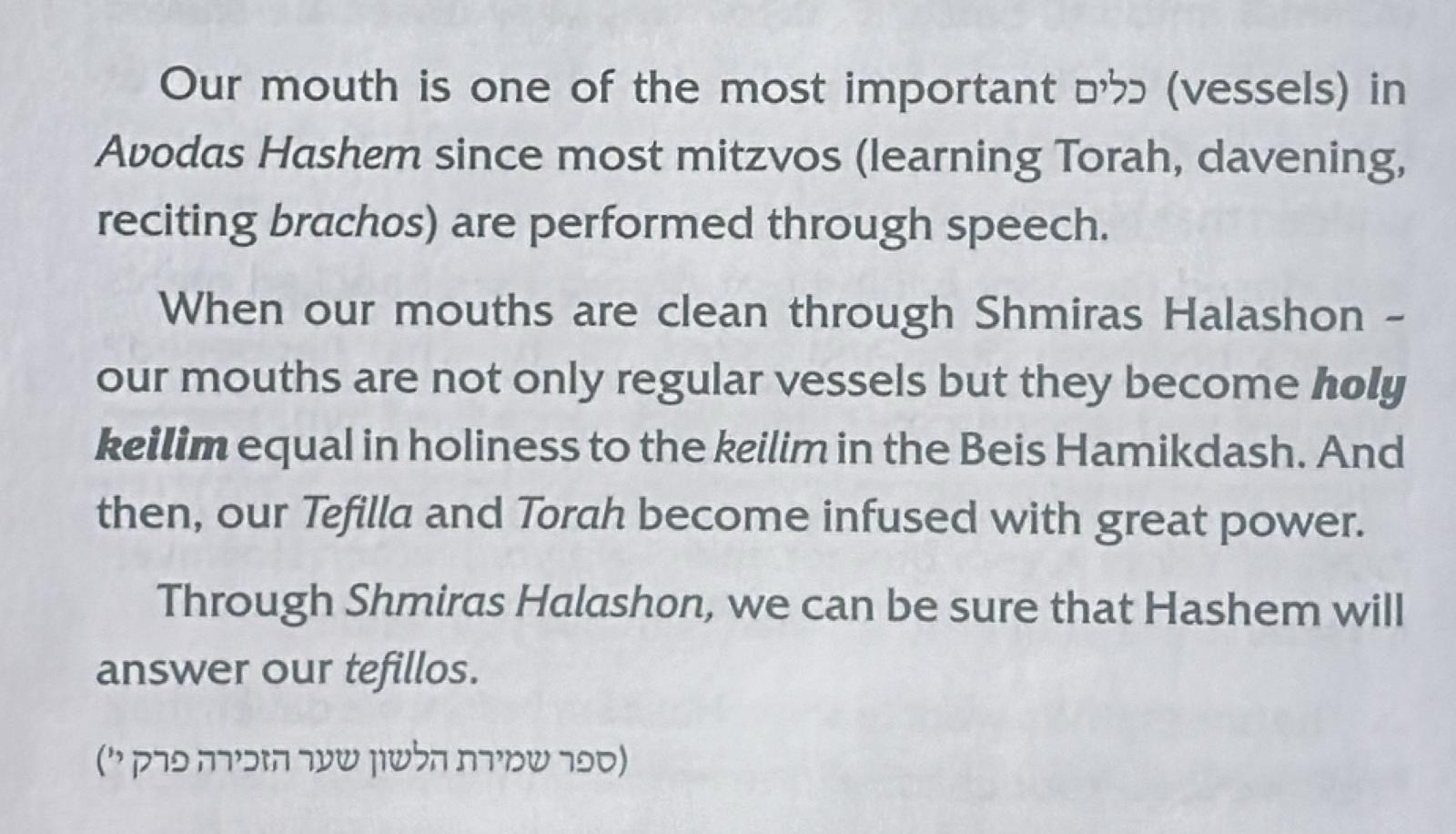
Day 74. The chofetz Chaim on when we guard our speech:
AvrohamTue, Jun 9 7:04 PM
Day 75. Avak Rechilus: Statements which do not contain outright negative information, yet nevertheless cause ill feelings fall under the category of Rechilus. For example: you tell your brother, “ yesterday when I mentioned your name to our neighbor, he said, ‘I don’t even want to talk about him”. Since this statement can cause your brother to feel hurt, it is forbidden.
Nesanel DevorWed, Jun 10 1:33 PM
Day 76. Avak Rechilus: Sometimes by praising someone, one can cause ill feelings. Example: Reuven and Shimon are partners in business. You tell Reuven “Your partner Shimon is so generous, last week he lent me $100,000 from the business.” Why is this forbidden you may ask? Because it can cause Reuven to be upset with Shimon for lending so many much money without his consent. It is also forbidden to repeat to another yid that someone praised him in a manner which can cause ill feelings. For Another Example: Reuven doesn’t want to lend you money. You argue with him and say “My friend said you lent him a large sum, how come you don’t want to help me ? This is forbidden because it will cause Reuven to experience ill feelings against your friend for informing you that he lent him money.
AvrohamFri, Jun 12 6:43 PM
Day 77. Avak Rechilus: It is forbidden to repeat a statement which people may be sensitive to, even though it is not negative. Example: your sister went on vacation, she left her children by a neighbor for a week. At a Later date, you tell your sister, “your neighbor told me she had a very hard week and wasn’t up to having your children.” Although the neighbor didn’t say anything negative, it is forbidden. Why? Because it might cause your sister to feel hurt by your neighbor.
Nesanel DevorSun, Jun 14 8:20 PM
Day 78. Avak Rechilus: Repeating a statement that can be interpreted in both a positive or negative way may fall under the category of Avak Rechilus . Example: Your neighbor tells you, “You know your mother is always cooking”. This statement can be interpreted negatively- your mother is very food minded. However, this statement can also be interpreted positively. Your mother always has guests and therefore she needs to prepare food. Are you permitted to repeat this statement to your mother? If it is repeated in a way that shows that the neighbor meant it as a compliment, then you will be allowed to repeat it but if not then you can’t repeat it. *Note of caution:* If your mother is sensitive or already bears ill feelings towards your neighbor then regardless it is forbidden to repeat this statement.
AvrohamMon, Jun 15 4:18 PM
https://chat.whatsapp.com/Fe75sDSkGMt2IYLjAWDFCQ?s=sw&p=i&ilr=0 For more videos and pictures like this join @33793138286686 chat 😄🔥🔥
Nesanel DevorTue, Jun 16 6:56 PM
Day 80. Rechilus: It is forbidden to repeat negative information even without mentioning who said it If the person will figure out who the speaker was. Example: You tell your friend, “Someone told me you played horrible in that basketball game yesterday”. Your friend will assume it’s Mr. so and so since he was the only one at the game that knew him.
AvrohamThu, Jun 18 3:16 AM
Day 81. Rechilus: It doesn’t make a difference to whom you are saying Rechilus. It is forbidden to relate Rechilus even to one’s family members. For exampleIf if someone talked negatively about your mother or father it is forbidden to repeat it to them, even if you are trying to protect them. It is also forbidden to relate Rechilus to a child.
Nesanel DevorThu, Jun 18 5:50 PM
Day 82:

AvrohamMon, Jun 22 12:39 AM
Day 83. Rechilus: It is forbidden to speak Rechilus to the relatives of the person who was spoken about. Why? Because the nature is that a person will bear a grudge against those who embarrass members of their family. Thus, it would be forbidden to tell a woman/man that someone spoke negatively about their spouse. It would also be forbidden to tell a parent that someone spoke negatively about their child. It would be forbidden to tell a sister/brother that someone spoke negatively about their sibling.
AvrohamMon, Jun 22 10:10 PM
Day 84. Rechilus: If a talmid chacham speaks negatively about someone it is forbidden to repeat it And it’s even worse than regular Rechilus. Why? • Because it is quite rare that a talmid chacham would speak against someone without a constructive purpose. Thus, by blaming a talmid chacham for speaking negatively, one is in essence lying. • Our Torah instructs us to support the talmidei chachamim and to give them honor. It is therefore really bad to cause someone to bear a grudge against them. • it is known that a person will be most offended when told that respected person spoke negatively about him. Therefore, your words can cause much hatred and machlokes.
Nesanel DevorWed, Jun 24 3:58 AM
Day 85. Rechilus: It is forbidden to talk Rechilus about a child. Example: “You see 10 year old reuvan being mean to your friends son”. You then tell your friend, “I saw reuvan being mean to your son”. *This is forbidden*. You may claim that you are doing a mitzvah by defending the child, However…… The Chofetz Chaim writes, “such a remark can lead to the most devastating atrocities. If one would try to figure out how many issurim can be transgressed, It would be too numerous to count”. What can occur as a result in your comment? Your friend upon hearing your comment will yell at reuvan. Then reuvans parents can get involved from that, consequently a full scale family feud may erupt. Therefore, it is forbidden to tell a parent what a child did to their child unless all conditions of toeles are met. (Which we will go over again soon.)
AvrohamThu, Jun 25 5:26 AM
Day 86. Preventing Rechilus: Refrain from asking people “what did he/she say about me?” If there is a strong chance that the response may contain negative information.
Nesanel DevorFri, Jun 26 4:30 PM
Day 87. Is It Rechilus?: If we implement the advice of the ramban to think before we speak, we will be saved from the grave danger of Rechilus. What should we think? How can we judge if a statement is rechilus? We must ask ourselves before speaking “will my words cause ill feelings to be aroused between two yidden”.
AvrohamSun, Jun 28 10:58 PM
Day 88. Teshuva for Rechilus😬: •One must feel regret for speaking rechilus. •One must confess to hashem that he said over Rechilus. •One must take upon oneself not to talk Rechilus in the future. •One must ask forgiveness from the person of whom he spoke😬😬😬
Nesanel DevorMon, Jun 29 5:09 PM
Day 89.

AvrohamWed, Jul 1 3:22 AM
Day 90. *Toeles*: Toeles is speech which is negative but permissible to relay for constructive purpose only. We will start to learn the conditions and halachos of toeles tomorrow iyh.
AvrohamYesterday 9:52 PM
Day 105. Believing Loshon hara: Believing Loshon hara is forbidden even when the person who is being spoken about is right there and doesn’t deny it. How can you not believe it? What should you think? Maybe this person is working on the middah of keeping quiet when others embarrass him🤷🏼♂️🔥